Send this to your favorite AI and keep the conversation going.
Sales and operations planning (S&OP) is a monthly process that brings sales, supply chain, operations, and finance together to agree on what the business expects to sell, what it can supply, and what it will cost. Some organizations refer to this as sales, inventory, and operations planning (SIOP) to emphasize the role of inventory in balancing demand and supply.
Typically covering an 18–24 month horizon, S&OP connects demand forecasts with production capacity, inventory requirements, and financial targets. The result is one executive-approved operating plan.
The challenge is getting those plans to agree. Sales may expect higher order volumes, while suppliers are already at capacity or inventory is tied up in slower-moving products. S&OP gives teams a way to resolve those differences before they affect purchasing, production, or customer commitments.
Key Takeaways
- S&OP is a monthly process that aligns expected demand with supply capabilities and financial targets.
- The six-step process moves from product and demand reviews through supply, finance, reconciliation, and executive approval.
- S&OP sets the medium-term plan, IBP connects planning to broader business strategy, and S&OE manages near-term execution.
- Forecast accuracy, inventory turns, service levels, and financial performance help measure whether the plan is working.
- AI helps teams improve predictions, evaluate scenarios, and automate more supply decisions between monthly cycles.
What Is the Definition of Sales and Operations Planning (S&OP)?
At its core, S&OP is a decision-making process. It helps organizations identify where expected demand exceeds available supply, where inventory investment may be too high, and which trade-offs need leadership approval.
Those decisions shape purchasing, production, inventory positioning, and customer commitments over the planning horizon.
S&OP at a Glance
| Planning frequency | Monthly |
| Planning horizon | Typically 18–24 months |
| Teams involved | Sales, marketing, supply chain, operations, finance, and leadership |
| Primary output | One approved demand, supply, and financial plan |
| Key metrics | Forecast accuracy, service levels, inventory turns, and financial performance |
For businesses managing multiple facilities, suppliers, or distribution channels, sales and operations planning software helps keep those plans connected as conditions change.
How Does the S&OP Process Work?
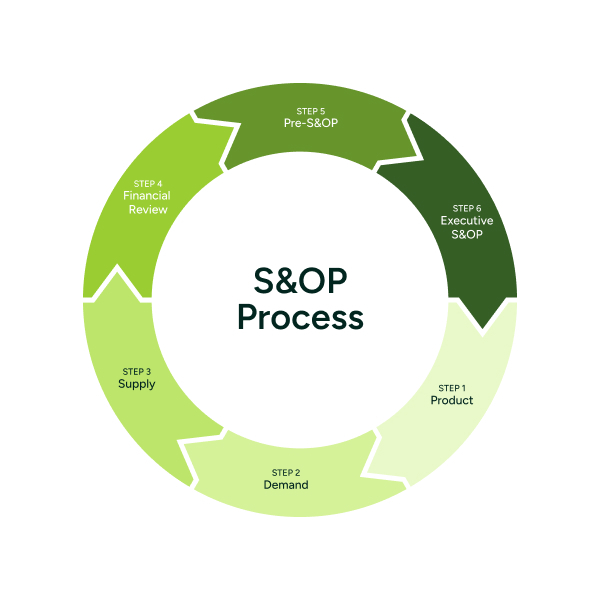
The sales and operations planning process flow follows six steps, beginning with a product review and ending with executive approval. Each step builds on the previous one, moving from demand and supply assessments to financial review and final decisions.
Step 1: Product Review
Product teams account for upcoming launches, discontinued SKUs, and other portfolio changes.
A product being phased out shouldn’t be planned the same way as one entering a growth cycle. These changes need to be reflected in the demand plan before supply planning begins.
Step 2: Demand Review
Sales, marketing, and demand planners review statistical forecasts against customer orders, promotions, pricing changes, and other demand drivers.
The result is a consensus, unconstrained demand plan that reflects what customers are expected to buy before accounting for supply limitations. Demand planning and forecasting provide the starting point.
Step 3: Supply Review
Supply planners test the demand plan against available capacity, supplier constraints, material availability, and projected inventory positions. The review identifies where the business can meet demand and where supply gaps are likely to develop.
Depending on the constraint, options may include adjusting production schedules, revising purchase quantities, reallocating inventory, or changing sourcing decisions.
Step 4: Financial Review
Finance evaluates the proposed plan against revenue, margin, cash flow, and inventory targets.
Building additional safety stock might protect service levels, for example, but it also ties up working capital. Those costs need to be understood before the business commits.
Step 5: Pre-S&OP Reconciliation
Functional leaders work through remaining gaps and prepare recommendations for decisions requiring executive approval.
Rather than bringing every issue to leadership, teams use scenario modeling and simulation to compare a few options with measurable cost, service, and inventory implications.
Step 6: Executive S&OP Meeting
Leadership reviews the recommendations, resolves outstanding trade-offs, and approves the plan.
The meeting should end with agreed priorities, assigned responsibilities, and a clear understanding of what happens next.
Sales and Operations Planning Example: Balancing Demand and Inventory
Consider a hypothetical wholesale distributor preparing for a seasonal increase in demand. Sales expects orders for a key product category to rise by 20% over the next quarter, but several suppliers are already reporting longer lead times.
Here’s how the S&OP process would help the distributor respond:
- Product Review: Identify which seasonal products are driving the expected increase.
- Demand Review: Update forecasts using customer orders and historical seasonal patterns.
- Supply Review: Check supplier capacity, lead times, and inventory availability across distribution centers.
- Financial Review: Compare the cost of additional inventory against potential lost sales.
- Pre-S&OP Reconciliation: Evaluate inventory investment, sourcing options, and service priorities.
- Executive S&OP Meeting: Approve the approach that best balances product availability, inventory costs, and financial targets.
The goal isn’t simply to meet the higher forecast. The distributor needs to decide how much inventory to invest in, where to position it, and how to manage supplier constraints without putting unnecessary pressure on working capital. The approved plan then guides purchasing and replenishment decisions.
Who Is Involved in S&OP, and Who Owns It?
Supply chain or planning typically manages the monthly S&OP cycle, but leadership owns the final decisions. A designated process owner coordinates the reviews, keeps the calendar moving, and brings unresolved issues to the executive team.
The roles below show who contributes to the plan and where decision-making responsibility sits.
| Role | What they bring to S&OP |
| Executive sponsor | Final decisions, trade-off calls, accountability |
| S&OP process owner | Runs the cycle, agenda, and data readiness |
| Sales & marketing | Customer intel, promotions, pipeline |
| Demand planning | Statistical forecast and consensus demand plan |
| Supply planning & operations | Capacity, materials, inventory plan |
| Finance | Revenue, margin, and cash impact |
What’s the Difference Between S&OP, IBP, and S&OE?
S&OP balances demand and supply over a monthly cycle. Integrated business planning (IBP) extends S&OP to the full business plan, including portfolio, strategy, and financial targets. Sales and operations execution (S&OE) handles the next 0–13 weeks, adjusting week to week to deliver the plan S&OP set.
| S&OP | IBP | S&OE | |
| Focus | Balance demand and supply | Align operations with the full business and financial plan | Execute and adjust the near-term plan |
| Horizon | ~18–24 months | Up to 36 months or longer | ~0–13 weeks |
| Cadence | Monthly | Monthly | Weekly |
| Led by | Supply chain / operations | Executive team / finance | Planners and operations |
| Output | Consensus volume plan | Integrated volume and financial plan | Weekly supply and allocation decisions |
Consider a supplier that suddenly pushes a delivery back three weeks. S&OE addresses the immediate impact on customer orders and available inventory. If the delay points to a longer-term capacity problem, that belongs in the next S&OP cycle.
S&OP vs. demand planning: Demand planning estimates what customers will buy. S&OP determines how the business will meet that demand while accounting for supply and financial constraints.
What Are the Benefits of S&OP?
A well-structured S&OP process can improve inventory performance, service levels, and operating costs. According to Gartner research published in Supply Chain Management Review, organizations with well-designed S&OP processes are 1.2 times more likely to outperform competitors on metrics such as on-time, in-full delivery, cost, and inventory.
One Plan Across Departments
A common planning cycle gives sales, operations, and finance a consistent basis for purchasing and capacity decisions.
Franklin Sports established a structured four-week S&OP cycle to coordinate sales forecasts, demand planning, and purchasing across its business.
Better Forecast Accuracy
Incorporating customer information and changing demand patterns helps reduce forecast error.
Belron achieved a 20% improvement in forecast accuracy and consolidated planning systems for more consistent forecasting and inventory decisions.
Right-Sized Inventory
Aligning safety stock and replenishment targets with demand requirements can reduce excess inventory while protecting fill rates across the distribution network.
Continental Battery Systems saw a 40% reduction in inventory and improved fill rates across a network of 150+ locations.
Higher Service Levels and Lower Operating Costs
Inventory positioning, replenishment policies, and product flows all affect service performance and cost-to-serve. Evaluating those decisions together can improve fill rates without increasing inventory investment.
ACR reached:
- 98% fill rate, up from the mid-70% range
- 25% reduction in inventory
- 27% reduction in outbound freight and warehouse costs
Stronger Financial Performance
Reducing unnecessary inventory and production costs can improve margins and free up working capital.
WIX Filters saw a $2.5 million improvement to their bottom line in less than 12 months with a 38% reduction in factory setups and a 15% reduction in active inventory.
What KPIs Should You Track in S&OP?
S&OP performance needs to be measured across forecast quality, supply execution, inventory, and financial performance. Forecast accuracy matters, but it won’t tell you whether the business is meeting customer demand or carrying more stock than necessary.
| KPI | What It Measures | Typical owner |
| Forecast accuracy | How closely forecasts match actual demand | Demand planning |
| Forecast bias | Whether demand is consistently over- or under-forecasted | Demand planning |
| Service level / fill rate | How consistently customer demand is fulfilled | Supply chain |
| Inventory turns | How efficiently inventory moves | Operations & finance |
| Plan adherence | Whether purchasing and production follow the approved plan | Operations |
| Plan vs. actual revenue and margin | Financial performance against expectations | Finance |
Look beyond the aggregate numbers. A forecast can perform well at the product-family level while masking SKU-level bias, shortages at specific locations, or inventory that isn’t moving. Those differences matter when planners set replenishment targets and allocate supply.
What Are the Biggest S&OP Challenges, and How Do You Fix Them?
One of the biggest problems with S&OP is the amount of work required to prepare for it. When planners spend days reconciling spreadsheets, correcting data, or resolving conflicting forecasts, there’s less time to evaluate the decisions that matter.
These are some of the most common issues that slow down the process and what organizations can do about them.
| Challenge | What Happens | What Helps |
| Different forecasts | Departments work from conflicting assumptions | Establish one consensus demand plan |
| Poor data quality | Teams spend days reconciling information | Assign data ownership and connect systems |
| Manual data preparation | Data preparation consumes the monthly cycle | Automate forecasting and repetitive analysis |
| Meetings without decisions | Trade-offs remain unresolved | Bring specific options and recommendations |
| Limited participation | S&OP becomes a supply chain-only activity | Assign clear responsibilities and executive ownership |
How Mature Is Your S&OP Process?
Having a monthly S&OP meeting doesn’t necessarily mean the process is working. The better test is how much preparation it takes, how often the plan changes, and whether teams follow through on the decisions.
S&OP maturity generally falls into four stages:
- Reactive: Departments plan independently, with frequent shortages, excess inventory, and schedule changes.
- Standard: Monthly reviews are established, but planners still spend considerable time gathering and reconciling data.
- Integrated: Demand, supply, and financial plans are connected, with scenarios reviewed before major decisions.
- Continuous: Planning updates more frequently, with automation handling more routine supply decisions.
The next step depends on where the process is breaking down. For some organizations, that’s improving forecast quality. For others, it’s reducing manual work or connecting supply decisions to financial targets.
How Is AI Changing S&OP?
Monthly S&OP cycles establish the plan, but demand signals, supplier lead times, and inventory positions change throughout the month. By the time the next review comes around, some of the assumptions behind the approved plan may already be outdated.
Improve Forecast Accuracy With AI-Driven Predictions
Static lead times and historical demand averages don’t always reflect current supplier performance or purchasing patterns. GAINS uses machine learning to improve demand predictions and estimate supplier lead times based on changing conditions.
More accurate inputs help planners set replenishment quantities, determine when to place orders, and assess whether the supply plan can support expected demand.
Automate More Complex Supply Decisions With Agentic AI
Most routine replenishment decisions are already automated. The next opportunity is reducing the manual review required for purchasing decisions involving multiple constraints, competing priorities, or exceptions.
GAINS Supply Decision Automation learns from buyer behavior to handle increasingly complex decisions, with human review where needed. That means buyers can spend less time reviewing purchase orders and more time addressing supplier constraints and exceptions.
Test Supply Chain Scenarios Before Making Changes
When a supplier misses a delivery or demand exceeds the forecast, the lowest-cost response isn’t always obvious. Planners may need to compare inventory transfers, alternate sourcing, revised production schedules, or changes to replenishment quantities.
GAINS uses scenario modeling, digital twins, and Decision Engineering & Orchestration™ (DEO) to help teams evaluate these alternatives across inventory, service, and cost.
AI doesn’t replace the S&OP process. It gives teams more current information and helps them manage decisions that shouldn’t wait until the next monthly review.
What Should You Look for in S&OP Software?
S&OP software should connect demand, supply, inventory, and financial information so teams can evaluate decisions using consistent data.
When evaluating an S&OP tool, look for:
- Connected planning: Consistent forecasts, inventory targets, and capacity assumptions.
- ERP integration: Reliable operational data without constant manual reconciliation.
- Scenario modeling: Comparisons of cost, service, and inventory trade-offs.
- AI-driven forecasting: Predictions that account for changing demand and supplier lead times.
- Multi-echelon inventory optimization: Inventory requirements across the distribution network.
- Decision automation: Less manual work, with planners involved in higher-value decisions.
The software also needs to support execution. An approved plan has limited value if purchasing, inventory, and operations continue working from different assumptions.
Bring Demand, Supply, and Financial Planning Together With GAINS
A good S&OP process should make it easier to act on the plan, not just agree on it.
GAINS brings forecasting, inventory optimization, supply planning, and scenario modeling together so teams can evaluate changes and make adjustments without starting from scratch each month.
Explore GAINS Sales and Operations Planning to see how our platform supports the process from planning through execution.
Frequently Asked Questions
How often should S&OP meetings happen?
S&OP typically follows a monthly cycle, with demand, supply, and financial reviews taking place before the executive meeting. Weekly S&OE meetings address shorter-term operational issues between cycles. Additional reviews may be needed when significant demand or supply changes occur.
What’s the difference between S&OP and demand planning?
Demand planning forecasts what customers are expected to buy. S&OP compares that forecast against supply capacity, inventory availability, and financial targets to determine what the business will do. Demand planning is one input into the broader S&OP process.
How long does it take to implement S&OP?
Implementation depends on the organization’s size, existing planning processes, and data quality. Some businesses start with a single product category or business unit before expanding. Establishing a consistent monthly process is usually the first priority, followed by improving data integration and planning capabilities.
Is S&OP only for manufacturers?
No. Distributors, retailers, and service parts organizations also use S&OP. For distributors, the process often focuses on purchasing, supplier lead times, warehouse inventory, and product availability rather than production capacity.
Can S&OP be automated?
Many activities can be automated, including data preparation, forecasting, scenario analysis, and routine supply decisions. AI can also monitor exceptions between planning cycles. Major trade-offs involving service priorities, capacity investments, and financial targets still require human judgment.
Related Resources
- How AI Demand Planning Reduces the Bullwhip Effect in Supply Chains
- Supply Chain Scenario Planning: Definition, Examples, & More
- What Is Agentic AI in Supply Chain Planning?
- GAINS Demand Planning & Forecasting
Send this to your favorite AI and keep the conversation going.