Send this to your favorite AI and keep the conversation going.
The next evolution of supply chain planning is not about generating more recommendations. It is about making better, more connected decisions and learning from what happens next.
By Jeff Metersky, SVP, Strategy & Innovation, GAINS
For decades, supply chain planning systems have gotten better at producing recommendations. Forecasting has improved. Optimization has become more powerful. Machine learning can identify patterns traditional methods miss. Generative AI can make complex analysis easier to understand. Yet one of the hardest parts of planning has remained remarkably consistent:
The system recommends. The planner decides. This distinction matters because a recommendation is not a decision. A recommendation is the analytical output of the planning system – for example, approve a purchase order for this date – while a decision determines what the business will actually do. Experienced planners know this better than anyone. Every supply chain has what I call Decision Heroes: the planner who knows a supplier always promises Friday but delivers Tuesday; the buyer who recognizes that a customer loads orders at the end of every quarter; the analyst who can look at a mathematically sound recommendation and know that, in this particular situation, it is commercially wrong. The planning system knows the structure. Experienced planners know the reality and have filled the gap between the two for decades.
The Planner Has Been the Learning System
A modern planning solution can know enormous amounts about a supply chain: demand, inventory, sourcing relationships, lead times, capacity, service targets, constraints, policies, and costs. Unfortunately, much of the context that enables a planner to convert a recommendation into a good decision still lives somewhere else: in spreadsheets, conversations, workarounds and, most importantly, in people’s heads.
Consider a planner who changes a recommended order from 500 units to 350 because the apparent demand spike looks like channel loading. The recommendation did not become the decision as the planner added context and judgment the system did not have. The planner also observes what happened, remembers whether that judgment was right, and applies the learning the next time a similar situation occurs. Currently, planning systems do not learn from planner overrides or evaluate the effectiveness of past recommendations.
As a result, the planner has effectively been the learning system. This is the gap that I believe the next generation of supply chain planning needs to close. The objective is not to eliminate planner judgment but make that judgment more scalable by allowing the system to capture more of the context behind decisions, observe what happened, and use that evidence to improve what happens next.
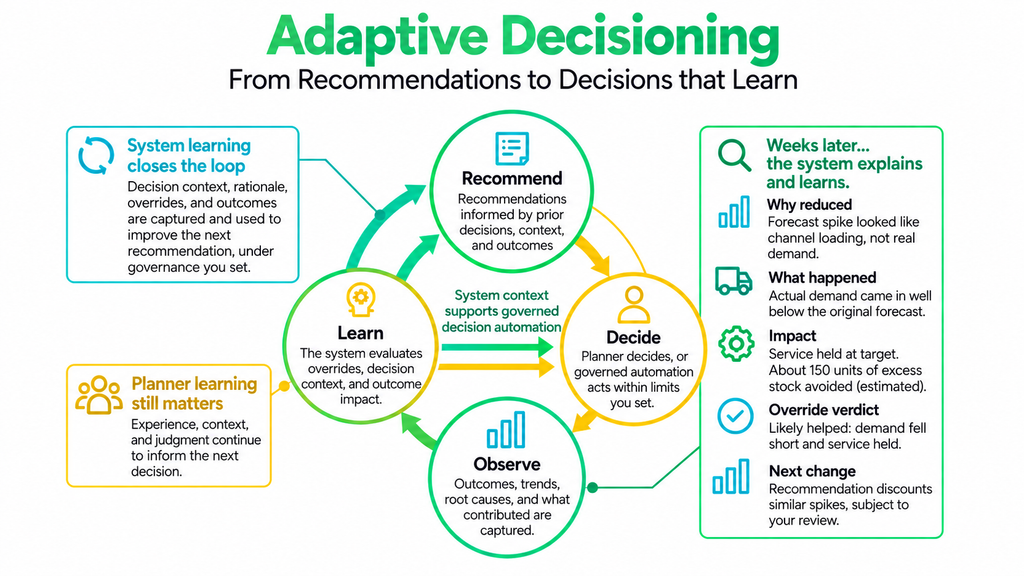
We call this direction Adaptive Decisioning. Imagine the same 500-to-350 decision in a more complete decision system where the planner changes the recommendation and records why. The system preserves the context and rationale, observes the eventual service, inventory, demand, and cost outcomes, and uses that evidence to improve future recommendations and determine when similar decisions can safely be handled with less intervention or fully automated. This is fundamentally different from simply improving the original forecast or explaining a recommendation with AI. It is moving toward a system that increasingly supports the full decision cycle: recommend, decide, observe, learn.
From Better Planning Software to an Intelligent Decision Platform
This is the strategic direction behind what we call Decision Engineering & Orchestration, or DEO. GAINS is evolving from a portfolio of planning and design applications to an Intelligent Decision Platform that brings reusable intelligence and decision capabilities to the places they are needed. That does not mean replacing everything customers already use with another monolithic application. The goal is to build forward from what already works, introduce new intelligence where it creates value, and progressively connect decisions that have historically been made in separate applications, workflows, and time horizons. Elements of this model are already delivering value today, while others represent the direction in which the platform is progressively evolving. It also means resisting one of the biggest temptations in today’s technology market: calling everything AI.
AI Is Powerful, but AI Alone Is Not the Strategy
Different decisions require different methods. A routine approval may need a rule. A demand signal may benefit from machine learning. A network decision may require optimization. A policy may need to be tested through simulation before it is committed. Generative AI may help explain why a recommendation changed. An agent may coordinate several of those capabilities and eventually act within defined limits. The advantage is not any single model. It is applying the right intelligence to the right decision, while preserving the appropriate level of human authority. This is what we mean by Decision Engineering and Orchestration.
Better Decisions Are Connected, Not Isolated
Supply chain decisions are rarely independent. Where you stock affects how much inventory you need; inventory policies influence fulfillment; and fulfillment constraints affect replenishment and buying. Supply decisions influence service, working capital, and operating cost. Longer-term network and sourcing choices establish the structure within which daily planning decisions operate. And, what actually happens in execution should inform the next planning cycle and, ultimately, future network design decisions.
The result of one decision becomes an input to another. That is why orchestration matters. An intelligent decision platform should increasingly connect decisions across design, planning, and execution, then use actual outcomes to improve future decisions. This does not mean one giant algorithm making every decision. It means the right analytical methods, data, policies, and people working from a more connected decision context.
Decision-First. AI-Fueled.
If the objective is better decisions, the starting point for AI should be the decision itself:
- What business outcome are you trying to improve?
- What information is required?
- What tradeoffs matter?
- What method is best suited to the problem?
- Who should have authority?
- What happens if the decision is wrong?
Only then should we ask where AI adds value.
This discipline matters because, despite enormous investment and attention, the results of AI projects remain uneven. BCG reported in 2026 that only about one in five of 181 surveyed supply chain leaders saw meaningful value from planning automation, optimization, or AI. I do not read that as an argument against AI. I read it as an argument for being far more deliberate about where and how we apply it.
For decades, the goal of supply chain planning has been to improve outcomes such as service, working capital, operating cost, and resilience. These outcomes remain the fundamental measures of whether a decision is good. What is becoming increasingly important is our ability to improve how those decisions are made: how quickly the organization moves from signal to action, how much routine decision work consumes scarce planner attention, and whether people understand and trust the recommendations and actions being produced.
As a result, three outcomes become increasingly important:
- Decision velocity: reducing the time between recognizing a condition and acting on it.
- Planner capacity: applying scarce expertise to decisions where human judgment adds the most value instead of repeatedly processing routine recommendations.
- Trust and adoption: making recommendations and actions understandable, challengeable, and governable.
McKinsey has described the economic opportunity from AI as a decision dividend: value created through faster action, better use of existing assets, and opportunities that would otherwise be missed. This framing matters because the objective – service, inventory, cost, and resilience – has not changed. What is changing is our ability to improve the speed, capacity, and quality of the decision process that produces those outcomes. The goal is not more AI but better decisions and better outcomes.
Full Autonomy Is Not the Destination
Once planning systems move beyond explanation and recommendation into action, the next challenge is: how much authority should they have? Gartner forecasts that by 2030, only 5% of organizations implementing supply chain planning automation will autonomously make at least 10% of their planning decisions. That forecast reflects the caution among users of AI-powered planning systems evolving from recommendations to autonomous action.
Ou view goes further. The fully autonomous supply chain is not around the corner, and it is not the destination. So, the better question is: which decisions should be given autonomous authority, and under what conditions? At GAINS, we use a principle called RAPID: the Risk-Autonomy Principle for Intelligent Deployment. Agent authority should depend on the risk, consequence, context, and reversibility of the specific decision.
A routine replenishment decision for a fast-moving item may be highly reversible. If the system orders slightly too much or too little, another replenishment opportunity arrives quickly and the error can be corrected before the consequences compound. Significant automation may therefore be appropriate. A high-value purchase with a long lead time is much less reversible. Once committed, the business may be locked into months of supply, substantial working capital, or contractual commitments. Technology can analyze, recommend, and prepare the action while a person retains approval authority.
A decision to build or relocate a distribution center is effectively irreversible over the planning horizon that matters. Capital is committed, transportation flows change, facilities are established, and customer-service implications may persist for years. Technology can build models, test scenarios, and challenge assumptions, but the strategic commitment remains a human decision.
Importantly, autonomy is not assigned simply by decision type. Two replenishment decisions may deserve very different levels of authority depending on dollar exposure, lead time, available alternatives, customer impact, or the ability to recover if the decision is wrong.
That is governed autonomy. Authority should also be earned, not granted all at once. An agent may begin by monitoring and explaining, then recommend, then prepare actions for approval. Only when the evidence supports it should the agent act within clearly defined boundaries. Agents earn authority and people set the limits.
More Time for the Decisions That Matter Most
What does this mean for planners? The objective is not to eliminate planners but empower them. Gartner forecasts that by 2029, 60% of planner roles will shift from operational execution toward strategic oversight. That shift only creates value if we are thoughtful about what planners do with the capacity technology gives back. The opportunity is to move scarce expertise away from repeatedly processing routine recommendations and toward decisions where judgment, creativity, experience, and cross-functional tradeoffs matter most. Some examples of these types of decisions include:
- How should service strategies change?
- Should the network or sourcing strategy change?
- How should the company respond to tariffs or supplier risk?
- What happens if the assumptions behind an inventory strategy are wrong?
- What tradeoff should the business make between cost, service, inventory, and resilience?
These are the decisions I want planners to have more time for.
Heroism Is Not Scalable. Experience Can Be.
Decision Heroes have carried planning organizations for years. They have filled gaps in systems, reconciled conflicting information, applied judgment under pressure, and kept supply chains running when the answer was not obvious. That expertise remains enormously valuable, but this heroism is not scalable.
The knowledge, judgment, and experience behind it can be.
That is the promise of the GAINS Intelligent Decision Platform: not a system that replaces the decision maker, but one that helps capture what great decision makers know, connects the decisions around them, applies the right intelligence to each problem, learns from outcomes, and expands autonomy only where evidence and governance support it.
Organizations do not have to transform everything at once.
Start with an important decision and a measurable outcome. Understand how the decision is made today. Identify the information, intelligence, and human judgment it requires. Measure what happens. Learn from it. Then build forward.
Because in the end, the platform is not the hero. The decision maker is.
Want to learn how quickly your planners can move from recommendations to decisions – get in touch with GAINS.
Send this to your favorite AI and keep the conversation going.