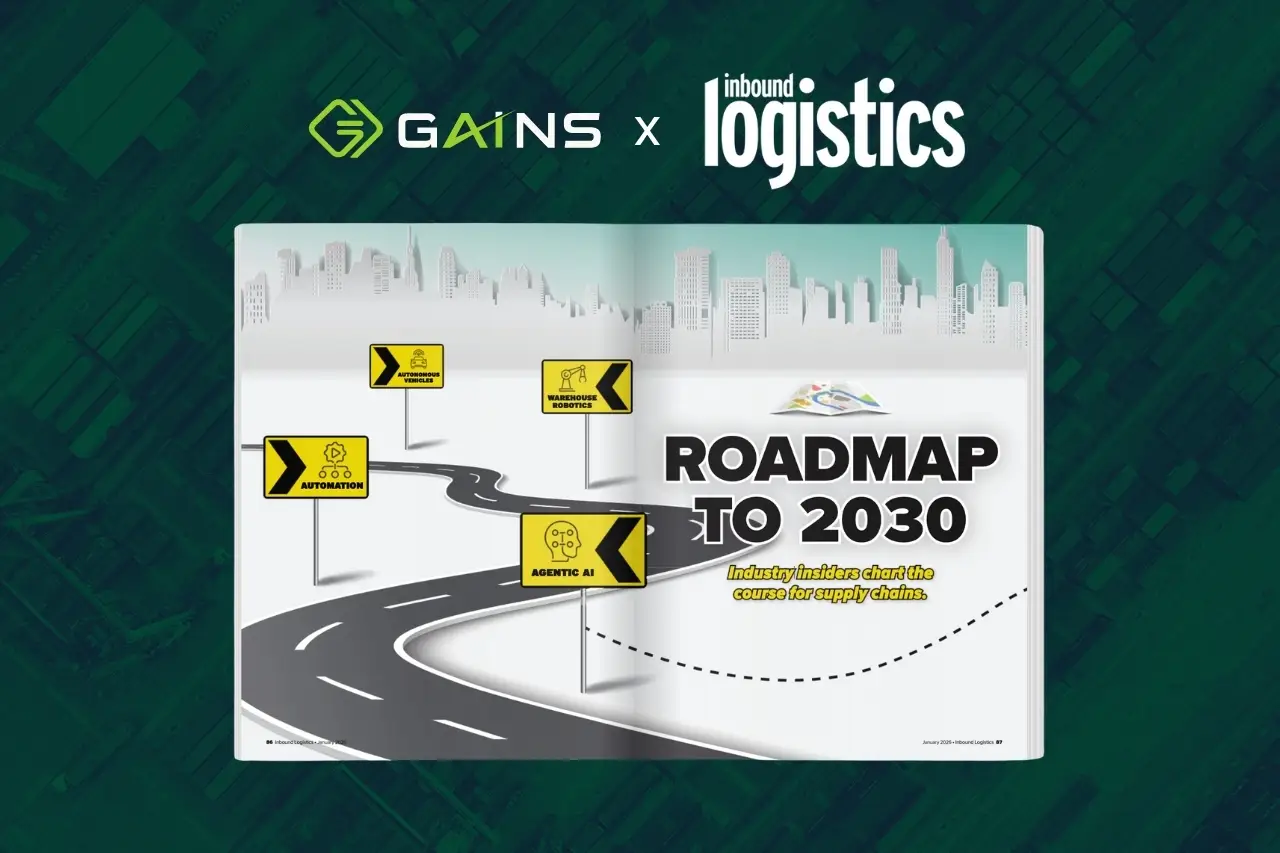
In the recent Roadmap to 2030 issue of Inbound Logistics, industry leaders shared where supply chains are headed—and what needs to change to keep up.
What stood out most to us wasn’t a single prediction or buzzword. It was a shared acknowledgment that the way supply chains have planned for the last few decades simply won’t hold up in the next one.
As Jeff Metersky, SVP of Strategy & Innovation at GAINS, put it in the article:
“Planning becomes a continuous, simulation-driven loop. Forecast rituals and heroic expediting don’t just lose ground; they become liabilities.”
That line resonates because most supply chain teams have lived it.
The Problem With “Heroics”
For years, success in planning often came down to experience, intuition, and last-minute saves. Someone spots an issue late, pulls a few levers, and gets things back on track. It feels impressive—but it’s also exhausting, fragile, and increasingly risky.
Volatility has changed the game. Demand shifts faster. Supply constraints appear with little warning. Costs move in real time. When planning happens in rigid cycles, by the time a plan is reviewed, it’s already outdated.
That’s why we believe planning has to be continuous. Not just updated more often—but fundamentally designed to simulate, test, and surface decisions as conditions change.
Why Static Network Design Is Fading
Jeff also touched on something we hear from customers all the time:
“The classic network design project won’t survive. The giant deterministic model refreshed every few years belongs to a slower era.”
Traditional network design wasn’t wrong—it was just built for a different pace of change. Today, networks don’t sit still long enough for episodic design projects to stay relevant.
Design can’t live in a slide deck anymore. It has to be connected to planning and execution, evolving alongside them. That’s why GAINS treats design, planning, and optimization as part of a single decision loop, not as separate exercises conducted years apart.
What “Self-Steering” Actually Means
One of the biggest buzzwords in the article was “self-steering supply chains.” It’s a phrase we’re hearing everywhere, and one that’s often misunderstood.
“Real self-steering means systems simulating continuously, surfacing decisions with clear trade-offs and taking action long before a meeting could be scheduled.”
To us, self-steering doesn’t mean removing people from the process. It means removing unnecessary chaos.
When systems can simulate continuously and handle routine decisions automatically, planners don’t disappear; they get their time back. They stay focused on the decisions that actually require judgment, context, and experience.
That balance—AI doing the heavy lifting, humans staying in control—is core to how we think about decision engineering.
A Broader Industry Shift
What made the Roadmap to 2030 especially compelling was how consistent the message was across contributors.
Partners like West Monroe and enVista pointed to agentic AI, AI-supported orchestration, and flexible, integrated platforms as priorities already showing up on executive dashboards. Different perspectives, same conclusion: supply chains need systems that can adapt continuously, not periodically.
See how GAINS leverages agentic AI with DEO!
Planning for 2030 Starts Now
The future outlined in Inbound Logistics isn’t about distant innovation. It’s about changing how decisions get made—today.
At GAINS, we see this every day with customers who are moving away from static plans and toward continuous, simulation-driven decision-making. Not because it’s trendy, but because it’s the only way to keep up.
2030 isn’t as far away as it sounds. And the supply chains that will succeed there are already changing how they plan now.
Ready to take the next step? Request a demo.